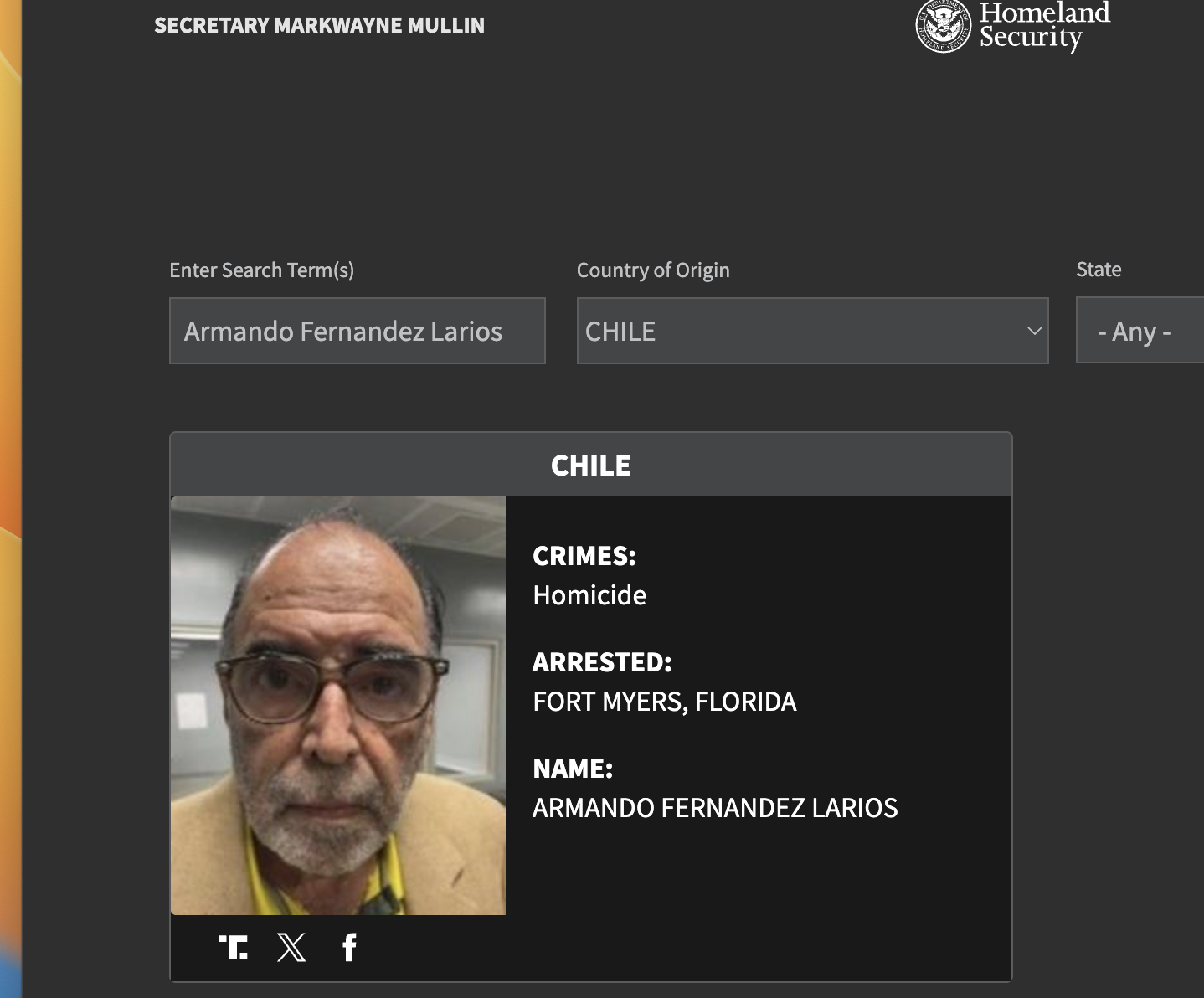
Washington D.C., July 10, 2026 - On October 27, 2025, U.S. Immigration and Customs Enforcement (ICE) agents quietly arrested Armando Fernandez Larios, a former Chilean secret police operative living in Florida. His incarceration at the Krome Detention Center in Miami remained a secret until he appeared on the Department of Homeland Security’s “worst of the worst” list—one of several Trump administration publicity stunts from January 2026 meant to demonstrate that ICE was rounding up immigrants with actual criminal backgrounds. Despite detaining Fernandez Larios for past crimes of “homicide,” ICE released him from custody on March 19th after he filed an “unlawful detention” lawsuit, according to court records posted today by the National Security Archive alongside declassified documents on his role in an act of international terrorism in Washington, D.C., 50 years ago. A March 30 ruling by Chief U.S. District Judge Cecilia Altonaga dismissed the Fernandez Larios suit as “moot” because ICE had already released him. But the ruling provides details on the latest twist in the saga of a notorious Chilean human rights violator who has been living freely in Florida for decades despite his involvement in the September 21, 1976, car-bombing operation that took the lives of former Chilean ambassador Orlando Letelier and his 25-year-old associate, Ronni Karpen Moffitt, in downtown Washington, D.C., and a jury finding of liability in a 2003 federal civil lawsuit for his role in an elite military unit known as “the Caravan of Death” that executed dozens of civilians after the September 11, 1973, coup. Among the declassified documents posted today is a State Department report on polygraph exams administered to Fernandez Larios after he sought to defect to the United States in early 1987 and convinced U.S. officials that he never knew his surveillance mission on Letelier was part of an assassination plot. The polygraph tests showed “consistent signs of deception in Fernandez’ disclaimers,” according to the report. Fernandez Larios pled guilty to being “an accessory after the fact” in the Letelier-Moffitt murders and testified that General Pinochet attempted to cover up Chile’s role in the car bombing; he served all of five months in prison for his role in that atrocity. In 2005, Fernandez Larios attempted to secure an “S” visa that protects foreign informants from ejection from the United States. But key U.S. government officials opposed granting him that protective status. “Some immigration officials have wanted to detain Fernández Larios to face deportation proceedings, citing his lack of any immigration papers and a 1996 law that mandates deportation of foreigners convicted of aggravated felonies,” the Miami Herald reported at the time. More than 20 years later, that little-known effort to deport him appears to have been revisited. Although Fernandez Larios is, once again, living freely in Florida, the upcoming 50th anniversary of the Letelier-Moffitt assassination is likely to bring renewed attention to his role in one of the most infamous atrocities ever committed on the streets of Washington, D.C. “If there is anyone who truly qualifies as ‘the worst of the worst,’ observes the Archive’s senior analyst on Chile, Peter Kornbluh, “it is Armando Fernandez Larios.” |