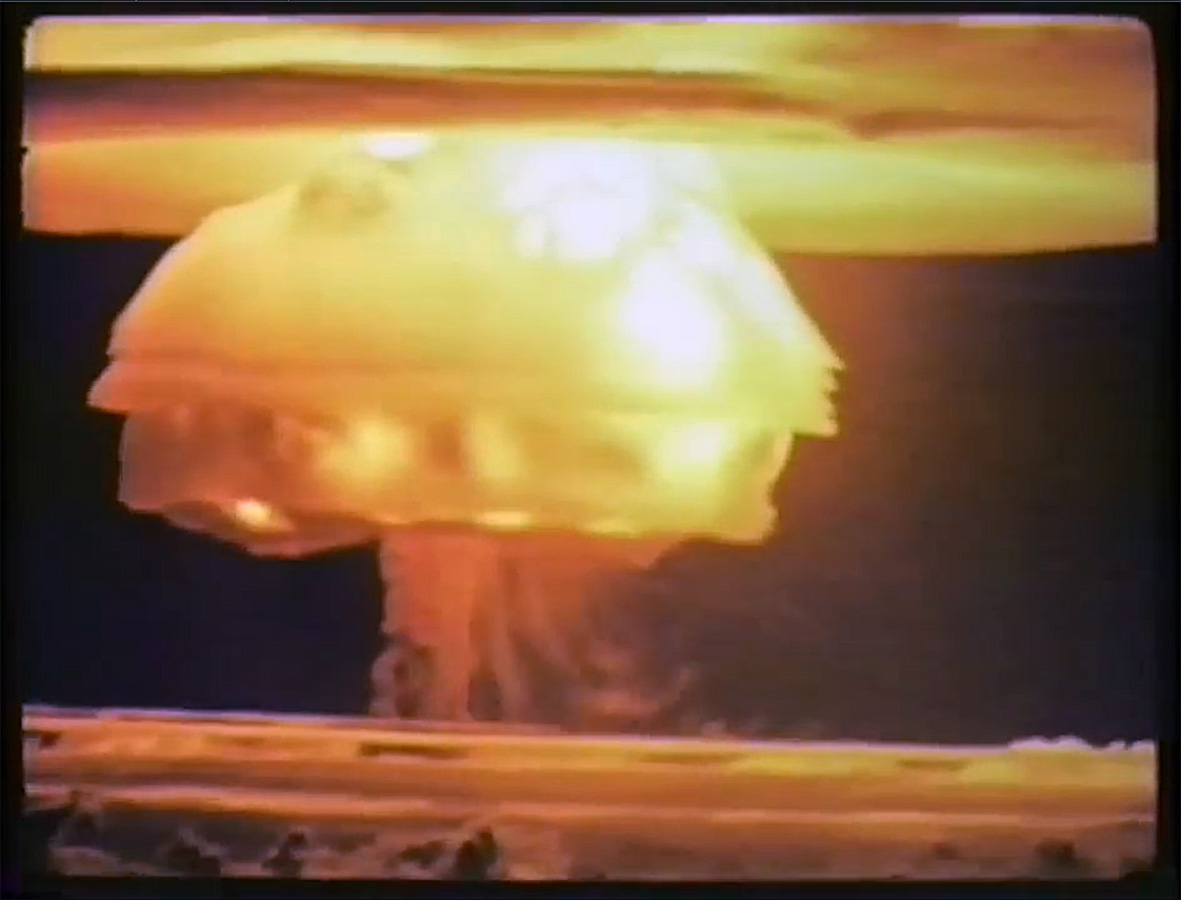
Castle BRAVO at 70:
The Worst Nuclear Test in U.S. History |
|
Washington, D.C., February 29, 2024 - Seventy years ago, the U.S. government air-dropped a massive thermonuclear weapon on Bikini Atoll in the Marshall Islands in what turned out to be the largest nuclear test in U.S. history. The Bravo detonation in the Castle test series had an explosive yield of 15 megatons—1,000 times that of the weapon that destroyed Hiroshima and nearly three times the six megatons that its planners estimated. The detonation vaporized some ten million tons of sand, coral and water that turned into a 100-mile-wide fallout cloud spewing radioactive debris on the inhabitants of Marshall Island atolls, U.S. military personnel, and Japanese fishermen aboard the Lucky Dragon. Bravo’s fallout necessitated the evacuation of over 230 people from Rongelap, Rongerik, and Utirik atolls (all part of the U.S. trusteeship for the Marshall Islands), including 28 U.S. military personnel. The immediate health effects were serious and long-lasting, and Rongelap became uninhabitable. To mark this calamitous event, the National Security Archive today features a selection of key documents on the Bravo test collected from three sources: the Department of Energy’s OpenNet database, Alex Wellerstein’s reconstruction of DOE’s vanished Marshall Islands Nuclear Document Database (MINDD), and from State Department records at the U.S. National Archives and Records Administration (NARA). Included in this update of an Electronic Briefing Book published ten years ago, on the 60th anniversary of the Bravo test, are several films of the Bravo shot, including a U.S. Air Force film report from the commander of Joint Task Force 7, the unit that conducted the Castle Series. That film includes footage of both the Bravo detonation and the evacuation of U.S. personnel and Marshall Islanders in the wake of the test. Other noteworthy documents in this posting include: - Early reports of radioactive contamination on nearby atolls and on the decisions, days later, to evacuate Rongelap, Utirik and Rongerik.
- The secret directive establishing “Project 4.1,” the group charged with producing a “Study of Response of Human Beings Exposed to Significant Beta and Gamma Radiation Due to Fallout from High Yield Weapons.”
- Japanese government accounts of the Lucky Dragon (Fukuryu Maru) incident.
- An audio recording and transcript of the 31 March 1954 press conference where AEC Chair Lewis Strauss said that an H-bomb could “take out a city … destroy a city.”
- The May 1954 petition by Marshall Islanders for an end to nuclear tests in the area.
- U.S. Embassy Tokyo telegrams on Bravo’s adverse impact for U.S.-Japanese relations.
- Internal U.S. government deliberations over providing compensation to the Japanese government and to Marshall Islanders for losses incurred due to nuclear testing.
- Documents concerning the delay in returning inhabitants to Rongelap Atoll because of unsafe conditions.
- U.S. government studies from 1954 and 1955 on the radiation and fallout effects of Castle Bravo.
- The proceedings of an October 1967 conference sponsored by the Defense Atomic Support Agency on “selected effects of general war,” including reflections and assessments by individuals involved in the initial response to the Bravo crisis.
- A comprehensive Defense Threat Reduction Agency report from 2013 on Castle Bravo exposing “legends and lore” about the test.
|
|
THE NATIONAL SECURITY ARCHIVE is an independent non-governmental research institute and library located at The George Washington University in Washington, D.C. The Archive collects and publishes declassified documents acquired through the Freedom of Information Act (FOIA). A tax-exempt public charity, the Archive receives no U.S. government funding; its budget is supported by publication royalties and donations from foundations and individuals. PRIVACY NOTICE The National Security Archive does not and will never share the names or e-mail addresses of its subscribers with any other organization. Once a year, we will write you and ask for your financial support. We may also ask you for your ideas for Freedom of Information requests, documentation projects, or other issues that the Archive should take on. We would welcome your input, and any information you care to share with us about your special interests. But we do not sell or rent any information about subscribers to any other party. |
|